Home / Early Intervention: The Right Support at the Right Time
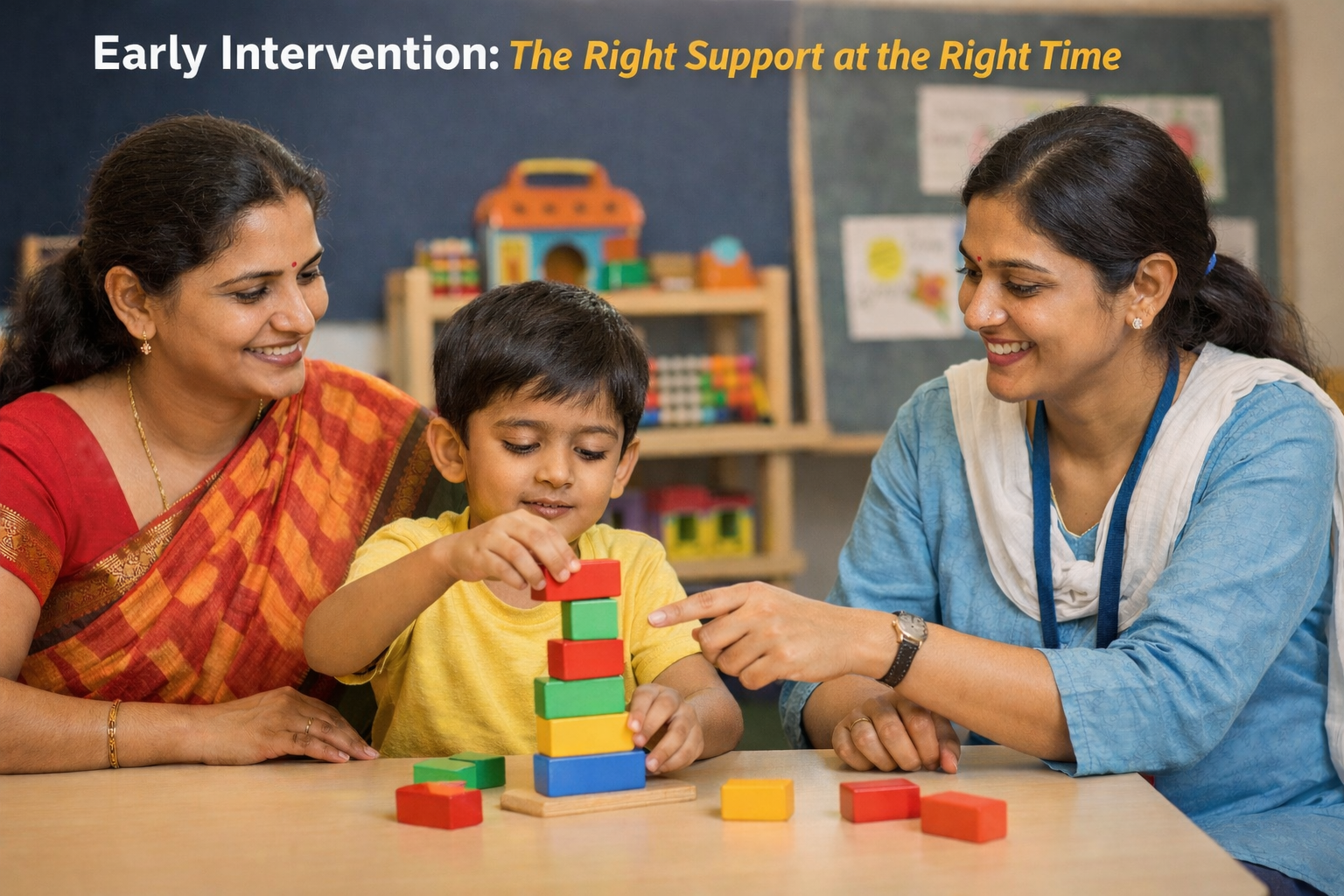
The early years of a child’s life form the foundation for lifelong learning, behaviour, and emotional wellbeing. From birth to age six, the brain develops at an extraordinary pace. During this critical window, the right guidance and structured support can significantly influence how a child communicates, learns, and connects with the world.
When developmental concerns are identified early, timely intervention can transform outcomes. Early intervention is not about labeling or limiting a child — it is about unlocking potential and building strengths.
At Jayaditya Foundation in Manikonda, Hyderabad, we believe that early understanding leads to meaningful progress — and meaningful progress changes lives.
Why Early Intervention Matters
Scientific research consistently highlights that early support improves outcomes in:
When support begins early, children gain the confidence and skills they need to thrive in school and daily life.
Early Identification → Timely Support → Lifelong Impact
The earlier developmental differences are understood, the greater the opportunity to build strong foundations for the future.
Looking Beyond Milestones
Progress in early intervention is not always about dramatic changes. Often, growth appears in small yet meaningful moments:
These seemingly small steps gradually build independence, connection, and self-confidence.
Every child develops at their own pace. With the right support at the right time, even small improvements can create lasting transformation.
The Role of Parents: Stronger Together
Early intervention works best when families and professionals collaborate closely.
Parents are not observers in the process — they are partners. With practical strategies and guided support, families become confident advocates in their child’s developmental journey.
At Jayaditya Foundation, we emphasize:
When families and professionals work together, children gain not just skills — but resilience and self-belief.
Understanding the Assessment Process
For many parents, the word “assessment” may feel overwhelming. But assessment is not about labeling a child — it is about understanding them better.
An early intervention assessment gently evaluates how a child:
The process typically includes play-based observation, structured interactions, and in-depth discussions with parents.
Assessment helps identify:
When understanding happens early, support becomes more effective — because the brain is most adaptable in the early years.
Developmental Challenges Identified Through Early Assessment
Early assessment allows professionals to understand growth across multiple developmental domains.
1. Speech & Language Challenges
Difficulty using words, understanding instructions, or expressing needs clearly.
2. Social Communication Challenges
Challenges with eye contact, joint attention, turn-taking, peer interaction, or play skills.
3. Autism Spectrum Differences (ASD)
Differences in communication patterns, social interaction, repetitive behaviours, or sensory sensitivities.
4. Global Developmental Delay
Delays across multiple developmental areas including cognition, communication, and motor skills.
5. Motor Development Challenges
6. Sensory Processing Differences
Over- or under-responsiveness to sound, touch, movement, or visual input.
7. Attention & Behaviour Regulation Challenges
Difficulties with attention span, impulse control, following instructions, or emotional regulation.
Early understanding does not mean permanent labeling. It means proactive support.
What Parents Should Remember
Early intervention is not about fixing a child.
It is about building strengths, creating opportunities, and supporting growth when it matters most.
Early Support in Manikonda, Hyderabad
For families in Manikonda, Hyderabad, access to structured and compassionate early intervention services is crucial. Having a trusted center nearby ensures consistent therapy, parent guidance, and professional collaboration.
Jayaditya Foundation provides evidence-based early intervention programs designed around each child’s unique profile. The goal is not just developmental improvement — but long-term confidence, independence, and readiness for school and life.
Develop individuals with ASD and Other neurological disorders to lead independent, functioning lives. Empower individuals with autism and their families for better inclusion in the community.
Plot No.95, Block A, Sector II, 2nd & 3rd Floors, Cocoon Saloon Building, Alkapoor Township, Puppalaguda, Hyderabad – 500089.
Call Us: 91- 9390771944
Open from Monday to Friday
10.00 AM - 18.00 PM